AUBURN TECHNOLOGY P-20A High Frequency Measurements Circuit Probe Rf
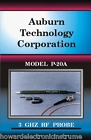
( Brand: Auburn Technology ), ( Model: P-20A ), ( Part Type: Circuit Probe ), ( Country/region Of Manufacture: United States )
Review AUBURN TECHNOLOGY Ghz High Frequency Measurements 20a Circuit Rf Probe
P 20a 3 ghz rf probe high frequency rf measurements with your spectrum analyzer or service monitor have become very easy and inexpensive with the rf probe from Auburn Technology. Special construction techniques of the 20a produce less than 1 pf of stray capacitance at 1 MHz to minimize the capacities loading affects on rf circuits. Rf instruments require low inductance grounding to make consistent and accurate measurements.
The 20 grounding barrel is a low impedance ground. Measurements from 100 khz to 1 ghz can be accurately measured by directly grounding the 20 grounding barrel or by using the short pin or flexible ground clip. Rf voltage measurements rf voltage measurements from 100 khz to 3 ghz can be made at 7 volts RMS continuously or up to 35 volts RMS for one second.
Rf circuits commonly have or nearly have a 50 ohm impedance and because of this, measurement errors will typically be insignificant for standard signal tracing techniques. Add 20 db to the instrument reading if in DBMS or multiply by 100 if using watts to get the power measurement for a 50 ohm source. 05 is the correction factor for the 20 loading characteristics for a 50 ohm source. Ground clips can be changed by grasping the ring portion of the clip and twisting it, while pulling to remove or pushing to assemble.
Accurate rf voltage measurements can be obtained by multiplying the instrument's reading by 10. Watt continuously or 44 DBMS 25 watts for one second.
Is provided to decouple in circuit supply voltage s. 95 in circuit rf measurements have become elementary the 20a is a passive 10 1 rf voltage rf probe with a 50 volt dc block built in. Users guide made in America designed by an engineer from fir systems designed for durability and high performance frequency response of various grounds. The 20a produces a 10 1 voltage ratio when used with instruments, such as rf volt meters and rf detectors while probing a 50 ohm source.
The 20a when used with a spectrum analyzer or rf power meter can effectively make in circuit rf power measurements with out the need for complex calculations. It has been designed to allow users of rf test equipment to use standard signal tracing techniques. An external attenuate should be used between the rf probe and the instrument to prevent the possibility of instrument damage due to excessive peak power.
Rf circuits commonly have or nearly have a 50 ohm impedance and because of this, measurement errors will typically be insignificant for standard signal tracing techniques. To prevent false readings or damage to test equipment, an internal dc blocking capacitor 50 volts max.
To minimize inductance, it better to make direct contact with the grounding barrel of the rf probe. Pulse power measurements up to 56 DBMS watts can be made, provided the average power level is less than 30 DBMS and the pulse duration is less than Rf grounding to obtain consistent and accurate rf amplitude measurements proper rf grounding is required.
Order the 20a from hie and receive a 60 day money back guarantee. True voltage measured v l ratio l ratio circuit impedance rf power measurements rf power measurements from 100 khz to 3 ghz can be made up to 30 DBMS. With the 20a 3 ghz rf probe includes replacement tips p20ax, p20as, and p20al price theory of operation a frequency compensated 450 ohm restive element is utilized in the rf probe design to reduce circuit loading and to give the 20a a 10 1 voltage ratio when connected to a 50 ohm instrument and probing a 50 ohm source. Download manual in page format download manual in manual format expand your rf test equipment capabilities.
If a good rf ground is out of reach, a 6 inch metal ruler or similar item can often be used to extend the ground to the rf probe. Verification of a low inductance rf ground can be accomplished by slightly changing the 20a ground contact position while observing that there are no significant changes in readings.
The 20a makes it possible to conveniently and accurately monitor or inject signals up to 3 ghz into rf circuits without significantly loading or detaining them.
An external dc block with a adequate voltage rating is also between the rf probe and attenuate to prevent possible damage to measurement equipment if voltage s greater than 50 volts are present. When a source with an impedance other than 50 ohms needs to be accurately measured, use the following equation to obtain the correction factor.
part #: p20a prices
- $49.95-$200.00
specifications stationaryenginezo:
- brand: Auburn Technology
- model: P-20a
- part type: Circuit Probe
- country/region of manufacture: United States
Returns:
- details: Restocking fee: No
- type: Money Back
- paid by: Buyer
- policy: returns accepted
- time: 14 Days
Seller:
- zipcode: 67042
- city: El Dorado, Kansas
Shipping:
- handling: days
- type: Flat
- cost: $5.0
General:
- Business & Industrial > Electrical & Test Equipment > Test Equipment > Probes
- condition: New
- in stock: Yes
Ratings:
- Great buy with fast shipping. Thank you 02-06-15
- As described in perfect condition Would do business again. AAAA++++ 02-04-15
- Very good quality item. Excellent value. Well packed, shipped fast. 5*! 02-06-15
- Excellent purchase! Smooth Transaction! Quick Delivery! 02-04-15
- Didn't need your labels,still nice 02-06-15
Payments:
- PayPal
Offer:
- # Sold: 0
- quantity: 10
- # bids: 0
- best offer: false
- Started: February 6, 2015, 7:30 pm